

The seat photo tells you almost nothing. Here’s what I actually check once the door closes on an A321neo in first.
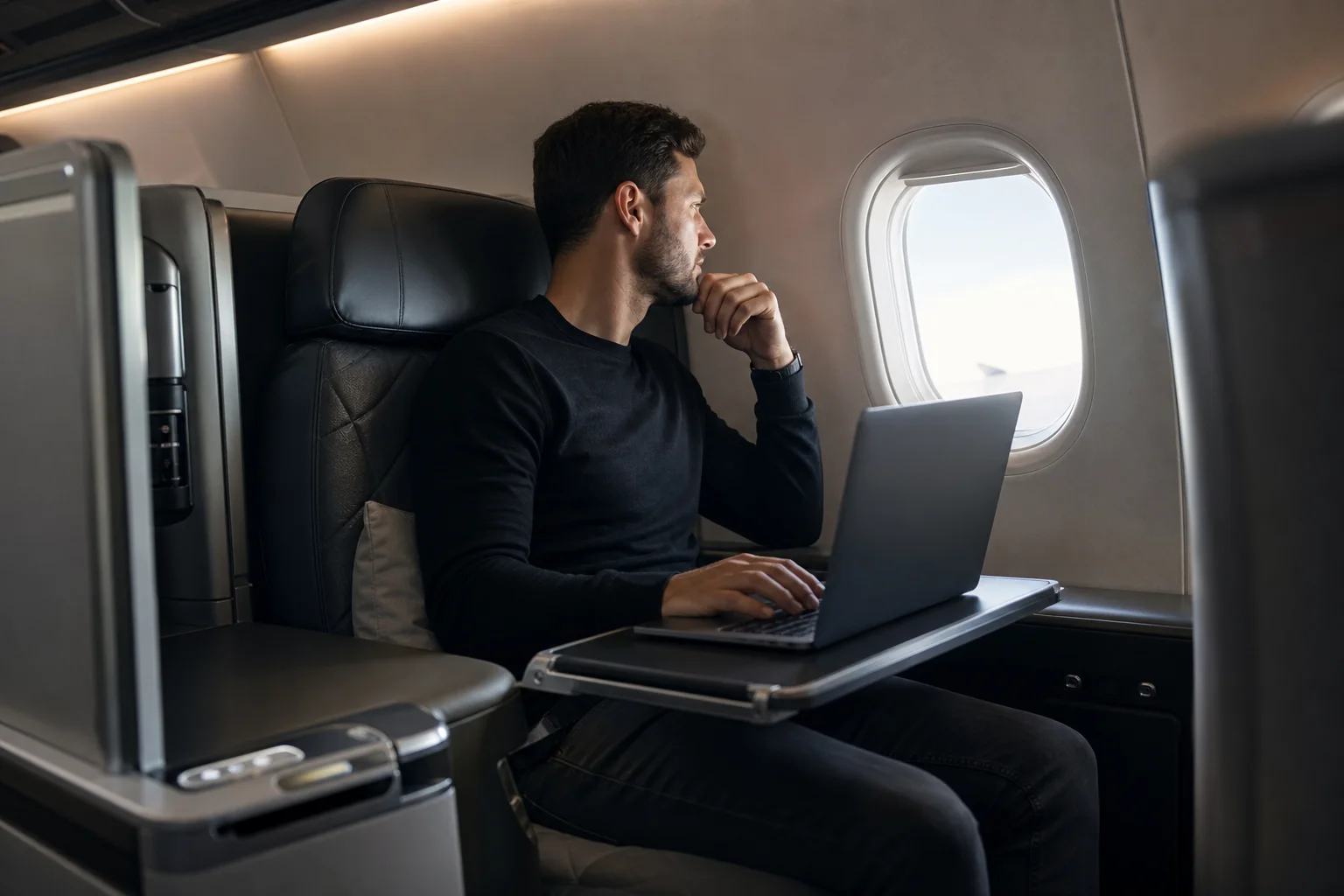
Every review of American’s A321neo first class starts the same way: a wide shot of the 1-1 recliner, maybe a close-up of the leather, and a caption about how it “feels like a mini business class.” I’ve taken that photo myself, more than once. It’s a good-looking seat. But a good-looking seat is not the same thing as a seat that does anything useful for you, and after enough of these domestic first class flights, the photo stops telling me what I actually need to know.
What I care about now is whether the seat earns its keep for the specific flight I’m on. A recliner with real pitch and a proper tray table is a genuinely different product on a three-hour transcon-style domestic leg than it is on a 55-minute hop between two nearby cities. Same hardware, completely different verdict, and that distinction almost never makes it into the seat-photo review.
The Tray Table Test
Start with the thing nobody photographs well: the tray table relative to your laptop. The A321neo first class tray is genuinely wide enough to hold a 14-inch laptop with a few inches to spare on either side, which matters more than it sounds like it should. On a lot of narrow-body first class seats, the tray is just barely wide enough for the machine itself, so your wrists end up resting on the edges of the table instead of on anything supportive. That’s a small thing for an hour. It’s a real problem for a three-hour flight where you’re actually trying to get work done and not just answer a few emails before descent.
Recline matters here too, but not in the way people assume. A first class recliner that goes back further is nice for napping and mostly irrelevant for working, because past a certain angle the tray table geometry stops cooperating with a laptop screen. The sweet spot is a moderate recline with the seat still close enough to upright that the screen sits at a usable angle. I’ve found myself bringing the seat back up from full recline specifically to work, which tells you the “recline” spec sheets brag about isn’t really the number that determines whether you get anything done.
A great seat wasted on a 55-minute flight is just an expensive place to sit down.
Power, Wi-Fi, and the Gap Between Marketing and Reality
Every seat map now shows a power icon next to first class, and on the A321neo that’s usually accurate — there’s a real outlet at each seat, not a shared one you’re fighting a neighbor for. Where it gets inconsistent is reliability. I’ve had outlets that work fine boarding-to-landing and I’ve had outlets that cut out somewhere over the Appalachians for no obvious reason. Bring a charged laptop and a portable battery regardless of what the seat map promises. The icon tells you the outlet exists. It doesn’t tell you it’ll still be live an hour into the flight.
Wi-Fi is the bigger gap between marketing and reality. It’s usually fast enough to stream something forgettable, which is the benchmark most reviews use. It is a different question whether it’s fast enough to be on a video call, upload a large attachment, or work through a VPN connection without the occasional stall. On most of these flights it’s fine for email and browser-based work and genuinely hit-or-miss for anything bandwidth-heavy. If a call is truly load-bearing for the trip, I don’t count on cabin Wi-Fi to carry it — I plan around a connection on the ground instead.
Noise Is a Seating Decision, Not a Cabin Decision
First class puts you at the front of the aircraft, and on the A321neo that means closer to the engines than a lot of people expect from a “quiet premium cabin.” The forward-most row or two can be noticeably louder than a row further back in the same cabin, especially during climb. It’s not disqualifying, but if you’re planning to work through the first twenty minutes of the flight instead of waiting for cruise, seat selection within first class is worth a few extra seconds of attention rather than just grabbing whatever’s open.
The Cabin
Boarding, Deplaning, and the Time You Actually Save
The part of first class that consistently delivers real value has nothing to do with the seat itself: boarding first and deplaning first. On a business trip with a tight connection or a car waiting, being among the first off the aircraft can be worth more than anything that happened in the seat. It’s a small, unglamorous benefit that doesn’t photograph at all, and it’s often the actual reason the upgrade or purchase was worth it.
Meal Service Versus Flight Length
This is where the seat-photo review really falls apart as a format. American’s domestic first class meal service is a real service — a proper tray, a real glass, an actual choice of entree on longer flights. On a three-hour-plus leg, there’s time to enjoy it, get some work done before and after, and still land rested. On a short hop, the same service becomes rushed by necessity: the crew is working against the clock, you’re catching your breakfast between drink service and the descent announcement, and the tray table you cared so much about for laptop use gets used for about eleven minutes total. The seat didn’t change. The math around it did.
| Seat | Wide, comfortable, tray table actually fits a laptop |
|---|---|
| Crew | Attentive, service pace matched flight length well |
| Wi-Fi | Fine for email, inconsistent for calls or uploads |
| Food | Solid on longer legs, rushed on short ones |
| Value | Strong on a 3-hour leg, questionable under an hour |
So What Actually Matters
If I’m deciding whether an A321neo first class seat is worth choosing — with points, a fare difference, or an upgrade — the seat photo answers almost none of the questions that matter. What I actually want to know is the flight length, because that determines whether the tray table, the recline, and the meal service have room to do anything. I want to know if I’ll be near the front of the cabin, because that affects noise during the part of the flight I’m most likely to be working. And I want realistic expectations for the Wi-Fi rather than the marketing version, because the gap between “works for streaming” and “works for a client call” is where a lot of business travelers get caught off guard mid-flight.
None of that shows up in a photo of a leather seat with good lighting. It shows up after you’ve sat in enough of them to stop being impressed by the recline and start asking what the seat is actually for on this particular flight.
A tray table wide enough to genuinely work on, paired with first-off deplaning when a connection is tight.
Wi-Fi that markets like a business tool and performs like a streaming convenience.
Yes, but only when the flight length gives the seat room to matter.
A three-hour-plus domestic leg where you actually intend to work or want a real meal.
The A321neo first class seat is genuinely good hardware, but its value is entirely a function of flight length. On a long domestic leg it earns its keep; on a short one, you’re paying for a recliner you’ll use for twenty minutes. Judge the flight before you judge the seat.

Leave A Comment