

Dallas doesn’t need a bucket list. It needs a schedule that respects what an evening arrival and a mid-afternoon meeting actually leave you.
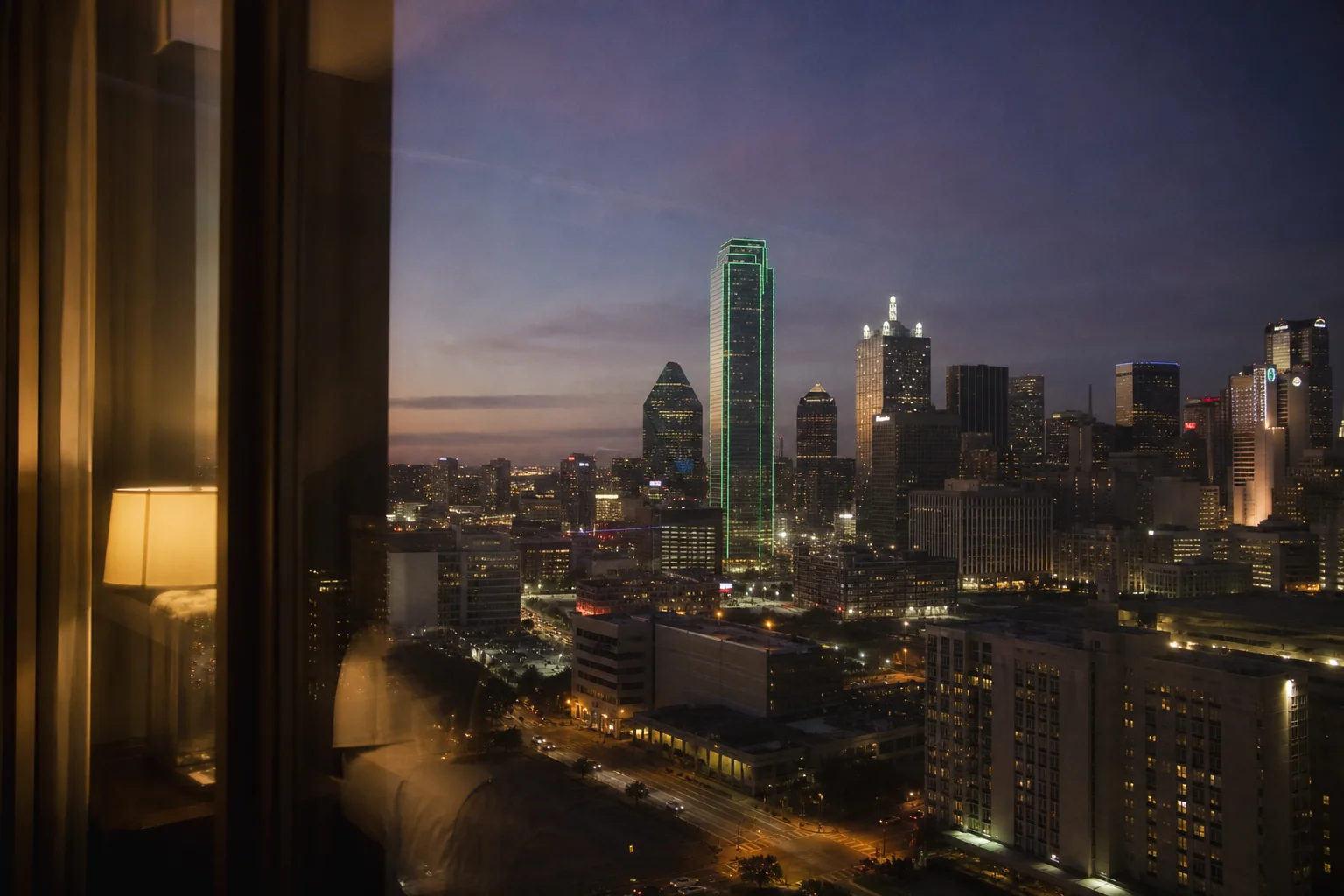
Most travel writing about Dallas starts with what to do there. That’s backwards for a trip like this one. I flew in for a single afternoon meeting, and everything else — dinner, the hotel, the next morning, the drive back to DFW — had to be built around that one fixed point on the calendar. That’s not a complaint. It’s just how a real business trip works, and honestly it’s a more useful way to think about a city than a top-ten list ever is.
This is what a tight, well-paced 36 hours in Dallas looks like when the schedule is the thing you’re actually optimizing.
Evening Arrival: What a Late Landing Actually Allows
An evening flight into DFW puts you on the ground somewhere between 7:30 and 8:30 depending on how the day’s schedule holds up, and that window matters more than people give it credit for. Land at 7:30 and you have a real dinner ahead of you. Land closer to 9:00, after a rental car or rideshare pickup and the drive into whichever part of the city you’re staying in, and you’re choosing between a late proper meal or something simpler near the hotel. Neither is wrong, but they’re different trips, and it’s worth knowing which one your actual arrival time buys you before you make a reservation you can’t keep.
I landed on the earlier end of that window this time, which meant an actual sit-down dinner was realistic without rushing it. Dallas has a food scene that doesn’t get talked about with the reverence of Austin or Houston, but it deserves more attention than it gets — there’s real depth in the barbecue and Tex-Mex here, plus a business-district dinner scene built for exactly this kind of trip: someone who wants a good meal without a production around it.
The itinerary isn’t built around what Dallas offers. It’s built around what the flight times allow.
Where You Sleep Matters More Than What’s Nearby
Hotel selection on a trip like this comes down to one question: which commute matters more, the one to your meeting or the one back to the airport? For a single-meeting trip downtown or in the Uptown/Design District corridor, I’ll pick a hotel that favors the meeting location over airport proximity, because you only make that drive to DFW once, at a time you can control. The drive to a downtown meeting during business hours, on the other hand, is the one variable you can’t fully plan around, so I’d rather absorb a longer airport run at the end than risk being late in the middle.
If the trip has no fixed downtown obligation — just flexible work and a departure the next day — the calculation flips, and staying closer to DFW starts to make more sense, especially with the airport’s own on-property and near-property hotel options cutting the return drive down to single digits in minutes rather than thirty-plus.
The Free Morning: Useful Without Overcommitting
A meeting scheduled for early-to-mid afternoon leaves a genuinely useful morning, and the temptation is to overfill it. I don’t. A morning like this is for one solid activity, not three rushed ones — a real breakfast, a walk through whichever part of downtown or the Arts District is near the hotel, maybe twenty minutes in a museum lobby if the timing works, and then back to the room with real margin before the meeting.
The margin is the point. Business travel goes wrong more often from overpacked mornings than from bad flights. If the plan requires four things to go right before 1:00 p.m. to make a 2:00 p.m. meeting, that’s not a morning itinerary — that’s a risk you’re choosing to take for no real benefit. One good thing, done without watching the clock, beats three rushed things every time.
Midday: The Meeting, and the Slack Around It
I build in a real buffer before any Dallas-traffic-dependent meeting — 30 to 45 minutes beyond what the map says, because downtown Dallas surface streets and the mix of one-way corridors can eat time in a way that doesn’t show up cleanly in a rideshare estimate. Arriving early to a coffee shop near the meeting location and working from there for twenty minutes beats arriving exactly on time and beats arriving late by an even wider margin.
Timing the Return to DFW
If your flight home is in the 5:00–7:00 p.m. window, work backward from wheels-up: 45 minutes minimum at the gate for boarding, 30–45 minutes through TSA depending on terminal and time of day (worse at Terminal A and C during the evening bank), and at least 30–40 minutes for the drive from a downtown or Uptown hotel to DFW, more if your meeting runs into the front edge of afternoon traffic. That’s roughly two hours of buffer before departure, which should shape when the meeting needs to end — not the other way around.
Departure: Let the Flight Time Set the Last Few Hours
DFW runs a genuine evening departure bank, which is convenient for a trip like this but also means TSA lines can bunch up hard between about 4:30 and 6:30 p.m. as several banks’ worth of connecting and originating passengers hit security at once. If the meeting wraps around 3:30 or 4:00, I’d rather sit in an airport lounge for forty extra minutes with my laptop open than gamble on beating that crowd by a slim margin. A short, unhurried buffer at the gate is a better use of the last hour of a business trip than trying to squeeze one more thing out of the city.
Packing matters here too — not in a dramatic way, just practically. A trip built around a single afternoon meeting means one change of clothes for the meeting itself and something comfortable for the flight, which keeps the bag small enough to avoid the overhead-bin scramble on a full evening flight and skip checked-bag time entirely on the way home.
Why This Trip Shape Works
A 36-hour Dallas trip built this way isn’t trying to prove the city has more depth than a two-day visit can capture — it obviously does, and that’s fine. The goal is narrower: get the meeting right, eat one good meal, use the free hours without abusing them, and leave enough margin on the back end that a normal amount of Tuesday-afternoon traffic doesn’t turn into a sprint to the gate. That’s a trip that works, repeatable the next time the schedule looks the same.
An evening arrival timed early enough for a real dinner, followed by a morning with just enough breathing room to actually enjoy it.
Downtown Dallas traffic doesn’t show up accurately in a map estimate — the buffer has to come from experience, not the app.
Yes. A single-meeting trip built around DFW’s schedule rather than a sightseeing list is an efficient, low-stress way to work.
Business travelers with one fixed downtown obligation and enough flexibility around it to build a sensible morning.
Dallas rewards a traveler who plans around the flight bank instead of fighting it. Respect the evening TSA crunch, buffer the downtown drive, and the rest of the trip takes care of itself.

Leave A Comment