

Most of my hotel stays are one night, in and out before the property’s best features would ever come into play. That changes what actually matters.
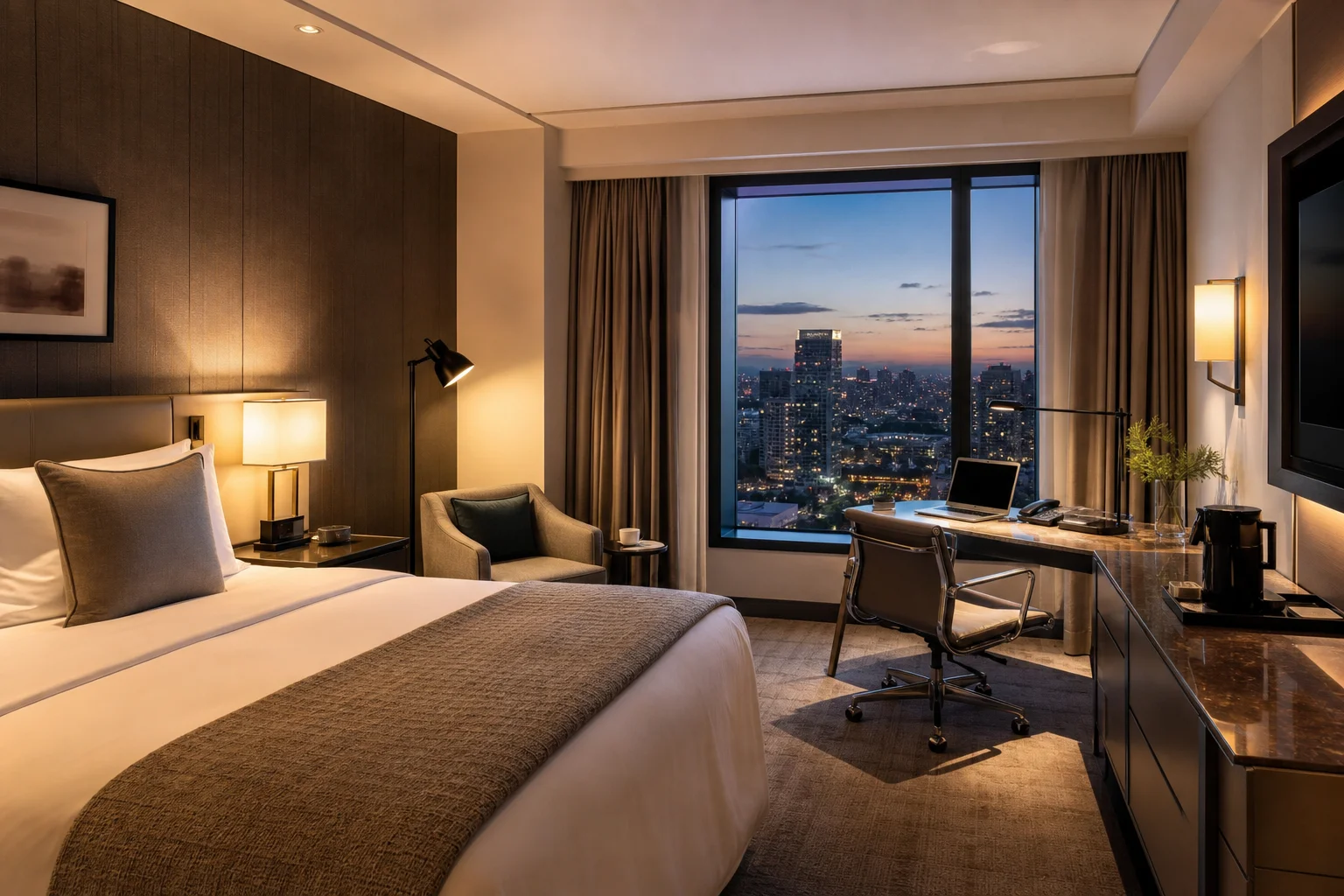
I stay in a lot of hotels for a lot of reasons, but the honest majority of those stays are one night. Land in the afternoon, work from the room for a few hours, sleep, get up early, fly home or fly on to the next city. I never see the pool. I rarely make it to the fitness center. The lobby bar is a place I walk past on the way to the elevator, not a place I sit down.
That reality changes how I evaluate a property completely. A hotel built around leisure amenities you’ll never touch and light on the basics you’ll use every single time is, for my purposes, a worse hotel than a plainer property that nails the fundamentals. So when I do a Hotel Check on a one-night business stay, I’m not scoring the rooftop pool. I’m scoring the five or six things that actually determine whether the stay did its job.
Check-In Is the First Real Signal
By the time I reach the front desk, I’ve usually been traveling for six or eight hours already. I don’t want a conversation. I want a key. Mobile check-in and a digital key that actually works on the first try tells me a property has invested in the parts of the stay guests experience most often, rather than the parts that photograph well in marketing materials.
When mobile check-in doesn’t work, the recovery matters. A front desk agent who can glance at a screen, confirm status, and hand over a key in under two minutes is functionally the same as a good mobile experience. A line, a hold-up over a credit card authorization, or a wait for a manager to sort out a rate discrepancy is where a stay starts going sideways before you’ve even seen the room.
A Desk You Can Actually Work At
This is where I’ve become genuinely picky. A lot of business-oriented hotel rooms have replaced the traditional desk with a small round accent table that looks fine in a photo and is useless for two hours of real work. There’s nowhere to put a laptop, a notebook, and a phone without them touching. The chair doesn’t adjust. The outlet is behind the nightstand instead of at desk height.
I want a rectangular desk with a chair that has some back support, an outlet or USB port within reach without unplugging a lamp, and enough surface area for a laptop and papers side by side. It sounds like a small thing until you’ve tried to finish an expense report balanced on your knees because the desk in the room was decorative.
A hotel room without a real desk isn’t a business hotel room. It’s a leisure room with a briefcase icon on the website.
Wi-Fi That Survives a Video Call
Free Wi-Fi stopped being a differentiator years ago. What matters now is whether it holds up under an actual video call, not just email and a browser tab. I’ve had elite-tier stays at recognizable business hotels where the connection dropped twice during a 30-minute call, and budget-adjacent properties where it never blinked. This is one area where brand reputation and actual performance don’t always line up, so I’ve stopped assuming and started testing it in the first five minutes after I get into the room, before I’ve unpacked anything.
A Room That Lets You Actually Sleep
The night before an early flight is not the night to discover the blackout curtains have a two-inch gap that lines up perfectly with a parking-lot light, or that the HVAC unit cycles on and off with a clunk every twenty minutes. I want real blackout coverage, quiet climate control, and a bed that doesn’t feel like a compromise. On a one-night stay there’s no second night to adjust or request a room change and still get the benefit of it. You get one shot at a good night’s sleep, and everything downstream of it — the flight, the meeting, the drive — depends on it.
The One-Night Bag Rule
For a single overnight, I pack as if I might not open the suitcase at all: a change of clothes, a dopp kit, chargers, and nothing that requires unpacking to access. Everything that goes on the desk goes on the desk in the first two minutes, and everything else stays zipped. It sounds obsessive, but it means checkout the next morning takes ninety seconds instead of ten minutes of hunting for a phone charger behind a nightstand.
Status Recognition, Compared Honestly
I carry mid-to-upper tier status with more than one major hotel program, and the honest answer is that recognition is inconsistent, brand to brand and property to property, in ways that don’t always track with the tier chart. At a business-oriented property in the Marriott family, I’ve found upgrades to a higher room category show up reasonably often when inventory allows, and the welcome amenity is usually straightforward — points or a simple breakfast credit, no negotiation required. At a comparable business-oriented Hilton-family property, I’ve had similarly good luck with room upgrades, though breakfast benefits have felt more property-dependent, with some locations honoring the full benefit cleanly and others treating it as an afterthought the front desk has to look up.
Neither pattern is a knock on either program in any absolute sense — a single business traveler’s experience across a handful of stays isn’t a statistically meaningful sample, and individual hotels under the same flag can run very differently depending on ownership and management. What I can say is that for a one-night stay, the benefit that actually moves the needle is late checkout or an early check-in window, because it buys back time on the day, not a room category bump I won’t be in the room long enough to enjoy.
The Loyalty Math Is Different for One Night
On a multi-night leisure trip, brand loyalty compounds: more nights means more chances for the upgrade to clear, more use of the lounge or breakfast benefit, more chances for a service recovery if something goes wrong early in the stay. On a single business night, none of that compounding happens. You get one interaction at the desk, one room, one breakfast if you’re up early enough to use it, and you’re gone. That means the brand that wins my one-night business stays isn’t necessarily the one with the richest loyalty program on paper — it’s the one whose baseline room and baseline service are reliably good without needing the loyalty math to bail it out.
| Check-in | Mobile key worked on first try; under two minutes at the desk when needed |
|---|---|
| Room | Clean, modern, no visible wear on furniture or fixtures |
| Workspace | Full-size rectangular desk, adjustable chair, outlet within reach |
| Status Recognition | Room upgrade offered; breakfast benefit honored without asking twice |
| Wi-Fi | Held a 30-minute video call without a single drop |
| Location | Ten minutes to the office, no highway merge required at rush hour |
| Sleep | Full blackout coverage, quiet HVAC, no hallway noise after 10pm |
| Value | Reasonable for a single business night; no resort-fee surprise at checkout |
None of this requires a five-star property or a dramatic lobby. It requires a hotel that has quietly gotten the fundamentals right and doesn’t make you think about them. On a one-night business stay, not thinking about the hotel is the whole point — the trip is about the meeting the next morning, not the room.
A real desk and blackout curtains that actually block light — the two things that make a short work session and a full night’s sleep both possible.
Status-based breakfast and amenity recognition that varies by property more than it should, regardless of brand.
Yes, for a business-oriented property that gets the basics right — desk, Wi-Fi, quiet, fast check-in — even without a memorable lobby.
Business travelers who need one clean, quiet, functional night, not a leisure experience.
For a single overnight, the amenities you’ll never use are irrelevant and the ones you’ll use in the first and last twenty minutes are everything. Judge the hotel on check-in speed, the desk, the Wi-Fi, and the dark and quiet of the room, and you’ll rarely be disappointed by the rest.

Leave A Comment